
Procrastination can be a distressing, and even exhausting, issue, because we don’t feel like we are doing this out of choice. Google’s AI defines it as ‘the act of delaying or putting off tasks, even when you know it could lead to negative consequences, and it stems from a failure in self-regulation, not laziness. It's often an emotional response, involving the brain prioritizing short-term relief over long-term goals, and it can be caused by anxiety, stress, fear of failure, or feeling unmotivated.’
I know I’m not the only one who has the mindset that I need to do something when the energy feels right or that I am waiting for the clarity of thought to arrive - for the sense that the words are gathered ready for me to use them with precision.
It isn’t classified as a mental illness, although it may be the result of depression or OCD.
Often neurodivergent struggle to complete a task in time, running up against a deadline and finishing at the very last minute. For some, they feel that the pressure is needed to get their brain working. They need the adrenaline to be firing, in order to focus, find clarity and use the energy to complete what is required. Others, who are perfectionists, fear that they won’t be able to get/do it right and they feel the need for it to be ‘the best’; previous experience of failure may be a deterrent. Some of us take on too much, don’t have the time to fit everything in and struggle to prioritise. Then again, the fear of change can also hold some of us back and we may struggle with what will happen after we have finished the task.
For those of us who work in a holistic way, a list is completely unhelpful, so the recommendation of a ‘to do’ list may be challenging. We benefit from a format that isn’t uncomfortably linear.
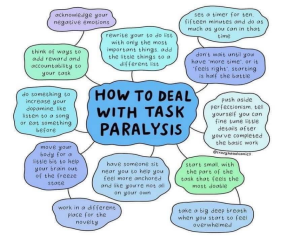
Suggestions for how to deal with it via Crazy Head Comics / Change Counseling
• Use dates in your plans: consider using a calendar and colour in dates with details of what needs to be done for that date. Use a different colour for each separate activity.
• Get a friend to help: ask someone who you feel comfortable with to help by talking through with you what needs to be done, maybe meeting once a week.
• ‘A step at a time’: looking at the whole task and the end goal may be daunting, so approach the journey and identify small steps along the way and start with ones that you feel confident about.
• Be aware of the signs that you are checking out: If you begin to let other things claim your attention, be firm with yourself and spend a little time (ten minutes) working on what you want to avoid.
• Identify what draws you away: practice putting your phone screen-side down, look out of your window and really focus on what you can see – shapes, colours, sounds – for no more than five minutes, then turn back to the task.
• Reward yourself: choose something you enjoy for when you complete one of the ‘to do’ tasks. Enjoy the feeling that you have completed it. Notice the difference from the feeling of panic, adrenaline flowing and exhaustion afterwards.